Rolled Threads on 3D-Printed Parts

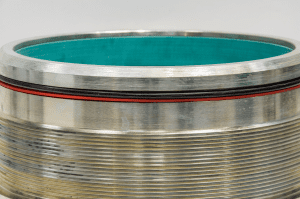
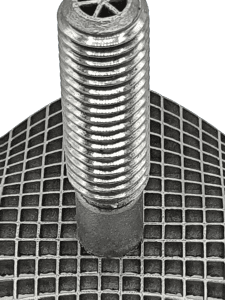
Complex part of CoCrMo alloy SLM printed with a post rolled threads - by Silbertool

Post-Rolled Threads in 3D Printed Parts - Powered by Silbertool

Precision Perfected: 3D Printed Threads by Silbertool in Aerospace-Grade CoCrMo Parts

In the world of aerospace engineering, where every gram matters and failure is not an option, threaded connections play a critical role. With the rapid adoption of metal 3D printing—especially for complex geometries using Cobalt-Chromium-Molybdenum (CoCrMo) alloys—designs once thought impossible are now being realized. But there has been one persistent issue: threads on 3D printed parts are often left with geometric imperfections and suboptimal surface finishes that cannot be post-processed using traditional means.
That is, until now.
Thanks to the breakthrough method of 3D printed threads by Silbertool, high-performance aerospace components can be post-processed with unmatched precision—even in materials like CoCrMo, which are notoriously difficult to rework.

The Challenge of Threading in 3D Printed Aerospace Components

Traditionally, threads printed directly into metal parts—especially those with internal geometries or functional cavities—have posed significant manufacturing limitations.
Conventional machining is often impossible or too destructive. Surface integrity is compromised, and in many cases, CoCrMo alloys resist post-cutting or thread chasing due to their hardness and work-hardening characteristics.
For aerospace engineers, this has meant that either:
  • Threads are machined separately and assembled later, adding cost and failure points, or
  • Compromised thread performance is tolerated, despite the risks.

3D Printed Threads by Silbertool: A New Standard in Thread Optimization

Through a non-cutting, cold-forming process, 3D printed threads by Silbertool are enhanced after printing without removing material. Instead, the thread flanks and root geometries are cold-formed into a rolled-thread-like finish, improving both:
  • Geometric precision, and
  • Fatigue resistance.
Even aerospace-grade CoCrMo parts—known for their high strength and wear resistance—can now be thread-perfectionized.
No cutting. No thermal stress. No material loss.

Applications in Aerospace: From Prototypes to Flight-Ready Parts

Wherever load-bearing threaded connections are found in:
  • Turbine housings
  • Satellite structures
  • Aerospace brackets
  • Hydraulic blocks
…3D printed threads by Silbertool are delivering new opportunities.
Design freedom is preserved. Mechanical integrity is ensured. And previously “unmachinable” parts can now be fully functionalized with aerospace-grade threads.

Proven, Patented, and Production-Ready

This post-processing method has been successfully tested on a variety of 3D-printed parts, including those fabricated from superalloys, titanium, and of course, CoCrMo.
Results have been documented by leading technical universities and aerospace R&D partners. The process is portable, scalable, and compatible with both powder-bed fusion and DMLS technologies.

Thread Quality Meets Additive Freedom

With 3D printed threads by Silbertool, aerospace design engineers are no longer forced to compromise between innovative geometries and mechanical performance. Even the most challenging materials—CoCrMo included—can now be post-processed for threads that rival, or even surpass, traditional rolling methods.
When performance must be trusted, and rework is not an option, 3D printed threads by Silbertool redefine what’s possible.

Standard tools available for

diameters: 3 to 120 mm
pitches: 0.5 to 4 mm
(and equivalent inch sizes)

Are you looking for thread repair tools?