
Chipless thread technology for stronger, more durable connections.
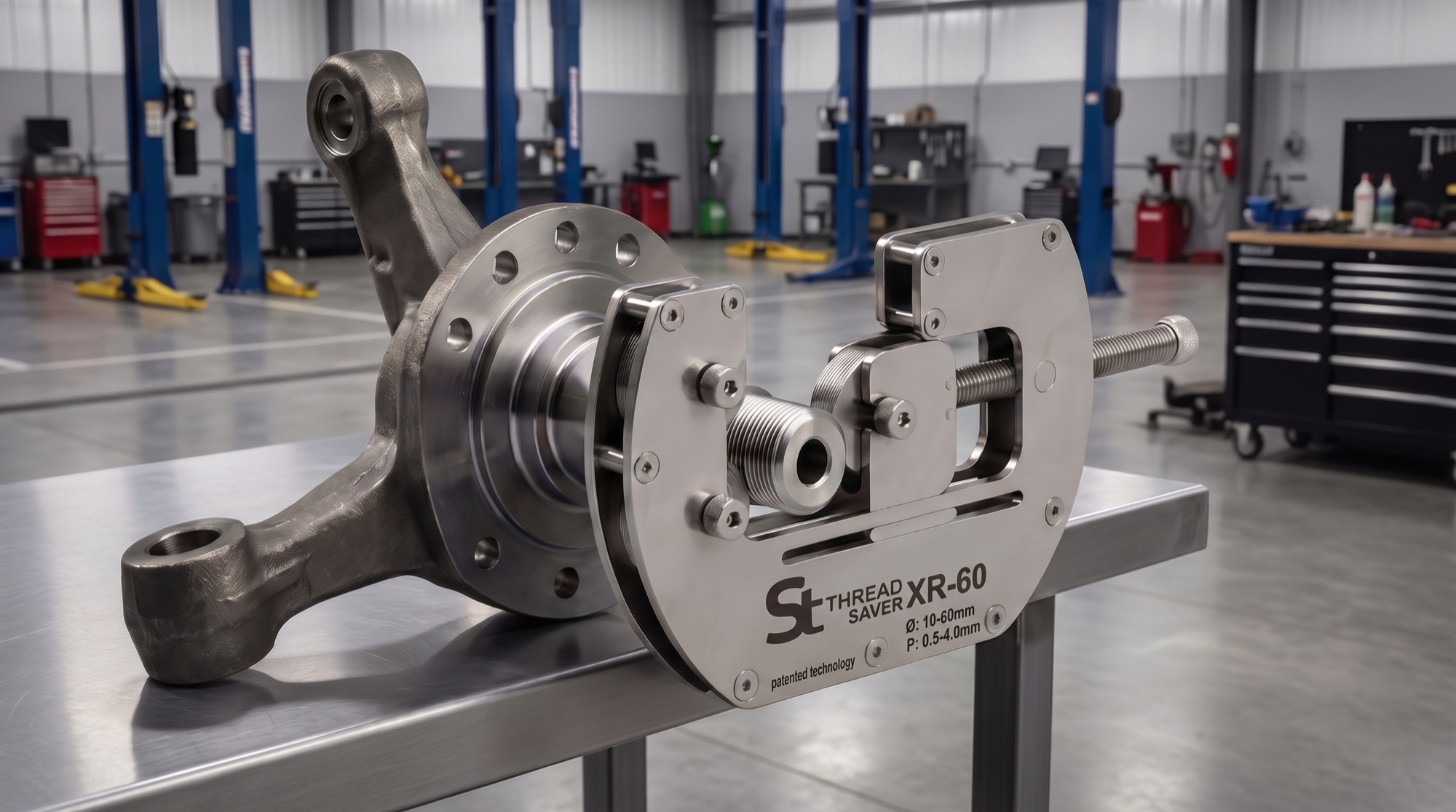
Thread geometry restored without cutting away the remaining profile.
The process uses controlled material displacement to recover thread geometry on real industrial components.
Chipless forming
Traditional thread production relies on cutting and removing material, which interrupts the material's natural fiber flow. Silbertool's cold-forming process creates new threads by precisely displacing material into the intended thread geometry, preserving the continuous fiber flow and producing a stronger, smoother, and work-hardened thread without removing material.
Geometry restoration
In restoration, displaced thread material is guided back toward the intended profile. The goal is to recover usability before cutting, tapping, welding, or replacement become necessary.
Performance optimization
In production, controlled cold forming improves surface finish, increases fatigue resistance, and strengthens the thread root - the area most vulnerable to stress concentration caused by the notch effect.
Before you cut, insert, weld, or replace.
Three routes. One forming logic.
Thread Restoration
For service teams facing damaged internal or external threads on high-value components. Silbertool helps reduce downtime by restoring recoverable geometry before more invasive repair routes are required.
Typical fit: fleets, MRO, workshops, hydraulic service, rail, heavy industry, commercial vehicles, and field repair.
Hybrid Thread Production
For manufacturers that need stronger or more durable thread performance without relying only on heavy rolling equipment or outsourced operations.
Typical fit: OEMs, machine shops, production engineering, safety-critical components, large or difficult materials, and flexible small-series manufacturing.
Post-Printing Threading
For additive manufacturing teams that need printed thread features to become reliable, functional connection points after printing.
Typical fit: AM service bureaus, aerospace, medical, R&D, high-tech production, complex geometries, and difficult-to-machine alloys.
Designed for demanding industries, not generic repairs.
Not every application belongs in a standard category.
Silbertool can support customers with standard products, application-specific guidance, or tailored solutions depending on thread size, material, damage pattern, operating environment, and performance objective.
For special equipment, non-standard materials, complex AM geometry, safety-critical components, or high downtime cost, the right next step is a focused review with Silbertool.
Request an application review